
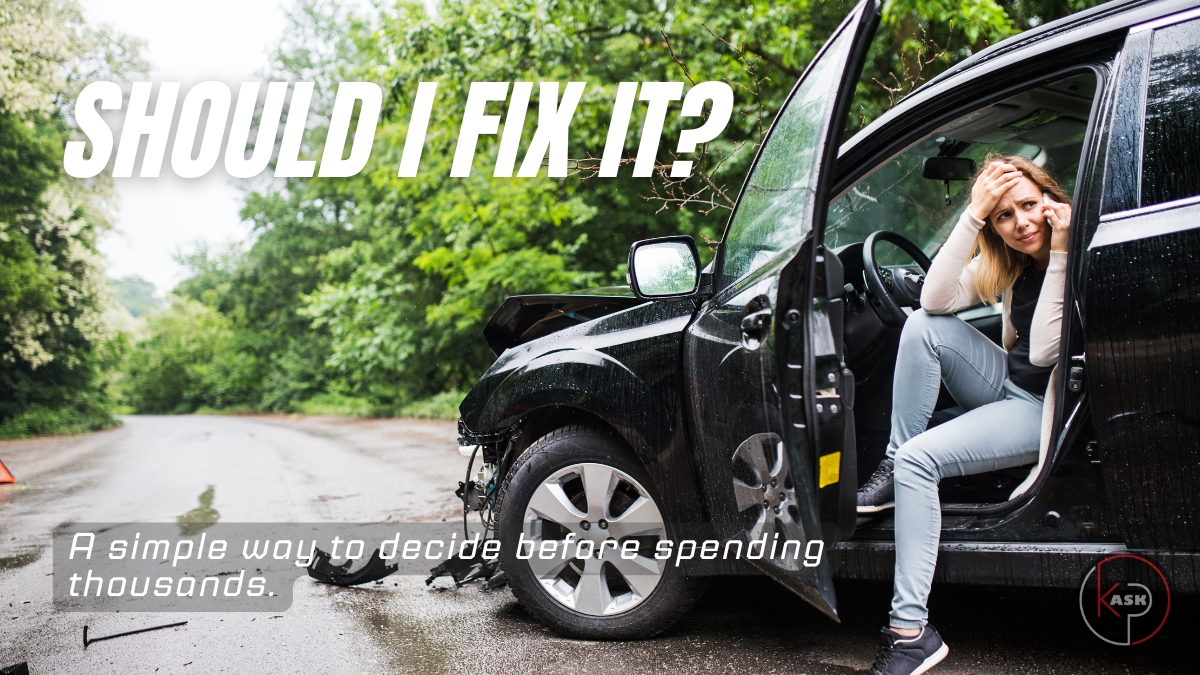
Should I Fix My Car or Buy a Different One?
A practical way to make one of the most expensive decisions most families face.
Few financial decisions create more stress than standing in a repair shop and hearing the words: "It's going to cost a few thousand dollars."
Suddenly you're faced with a question that feels much bigger than the repair itself: Do I fix the car I have, or is it finally time to replace it?
The wrong decision can cost you thousands of dollars. The right decision can save you money, reduce stress, and keep your finances on track.
The challenge is that many people make this choice emotionally. They get frustrated after another breakdown or accident. They panic when they see a large repair estimate. They convince themselves a newer vehicle will solve all their problems.
Sometimes replacing the vehicle is absolutely the right move. But many times, people trade a manageable repair bill for years of car payments they didn't really need.
The good news is that this decision doesn't have to be based on feelings. You can use a simple framework to determine whether repairing or replacing makes the most financial sense.
Let's walk through it.
Why This Decision Feels So Difficult
Cars are unique because they're both a financial asset and a daily necessity.
If your refrigerator breaks, you replace the refrigerator.
If your roof leaks, you repair the roof.
But when a vehicle needs a major repair, you're forced to weigh multiple questions at once:
-
How much is the repair?
-
How much is the vehicle worth?
-
How reliable will it be afterward?
-
How much would a replacement cost?
-
Can I afford another monthly payment?
-
Am I throwing good money after bad?
It's no wonder so many people feel stuck. The key is to stop asking one question and start asking four.
The Four Numbers That Should Drive Your Decision
Before making any decision, gather these four numbers.
1. The Cost of the Repair
Start with the actual estimate.
Don't round it down. Don't tell yourself it might somehow be cheaper.
Use the real number from a trusted mechanic.
Examples:
-
New transmission: $4,500
-
Engine repair: $3,200
-
Suspension work: $1,800
-
Air conditioning system replacement: $1,500
Once you know the repair cost, move to the next number.
2. The Current Value of Your Vehicle
Determine what your vehicle is worth today.
You can get a reasonable estimate from:
-
Online vehicle valuation tools
-
Dealer trade-in estimates
-
Local private-sale listings
The goal isn't perfection. You simply need a realistic idea of the vehicle's current market value.
For example:
-
Vehicle value: $8,000
-
Repair estimate: $4,000
Now you're facing a repair equal to 50% of the vehicle's value.
That doesn't automatically mean you should replace it - but it's an important signal.
3. The Expected Remaining Life of the Vehicle
This is the number many people skip.
A repair is not simply a cost. It's an investment in future transportation.
Ask your mechanic: "If I make this repair, what kind of life should I reasonably expect from this vehicle?"
Not perfection. Not best-case scenarios. Reasonable expectations.
Examples:
-
12 more months
-
3 more years
-
5 more years
-
75,000 additional miles
The longer the vehicle is expected to remain reliable after the repair, the stronger the case for fixing it.
4. The Monthly Cost of Replacing It
Now calculate what replacement actually means.
Many people compare a repair bill to a vehicle purchase price. That's the wrong comparison.
Instead compare: Repair cost vs. monthly ownership cost
Consider:
-
Down payment
-
Monthly payment
-
Insurance increase
-
Registration fees
-
Taxes
-
Interest costs
A vehicle that seems affordable on the lot can easily add hundreds of dollars per month to your budget. That monthly impact matters far more than the sticker price.
The Ask KP Car Decision Formula
Here's the simple formula:
Repair If:
Repair Cost ÷ Expected Months of Use = Less Than Monthly Replacement Cost
Let's use a real-world example.
Vehicle repair: $3,600
Expected additional life: 36 months
Monthly repair value:
$3,600 ÷ 36 = $100 per month
Replacement vehicle cost:
-
Loan payment: $450/month
-
Insurance increase: $50/month
Total replacement cost:
$500/month
In this scenario:
-
Keep current vehicle: about $100/month
-
Replace vehicle: about $500/month
Financially, repairing the vehicle is the clear winner.
When Repairing Usually Makes Sense
In many cases, fixing the vehicle is the smartest financial decision. Consider repairing when:
The Vehicle Is Otherwise Reliable
One major repair doesn't necessarily mean the vehicle is failing.
Sometimes a single expensive component wears out while the rest of the vehicle remains in good condition.
A transmission replacement sounds scary. But replacing a transmission can still be cheaper than replacing the entire vehicle.
You Have No Car Payment
This is one of the most overlooked factors.
Driving a paid-off vehicle creates tremendous financial flexibility.
Even a large repair may be cheaper than taking on a new five- or six-year loan.
Many people spend years trying to become debt-free only to jump back into debt because of a repair bill.
The Repair Extends Useful Life Significantly
A $2,500 repair that gives you three more years of dependable transportation may be a bargain.
The key question isn't: "How much is this repair?"
It's: "What am I getting in return?"
When Replacing the Vehicle Is Probably the Better Move
There are times when replacing the vehicle becomes the logical choice.
Repairs Are Becoming Constant
One repair is normal. Five repairs in six months is a pattern.
If you're repeatedly spending money and still losing confidence in the vehicle, replacement may be justified.
Reliability has value. So does peace of mind.
The Vehicle Has Major Safety Issues
Certain problems deserve serious consideration. Examples include:
-
Severe structural rust
-
Frame damage
-
Airbag system failures
-
Significant safety-related defects
If safety becomes questionable, the math changes quickly.
The Repair Exceeds the Vehicle's Practical Value
A common guideline is the 50% Rule. If a repair exceeds roughly half of the vehicle's market value, replacement deserves careful consideration.
This isn't a hard rule. It's a warning sign.
The vehicle may still be worth repairing if it's otherwise reliable.
But the larger the repair relative to value, the more cautious you should become.
You Can't Trust the Vehicle Anymore
This is difficult to quantify, but it's real.
If you're constantly worried about breakdowns, missed work, stranded family members, or expensive towing bills, reliability has become part of the equation.
Transportation isn't just about dollars. It's also about confidence.
The Most Expensive Mistake People Make
Many people replace a vehicle because they're tired of it. Not because the numbers support the decision.
A $3,000 repair feels painful because you pay it all at once.
A $35,000 vehicle feels easier because the cost is spread across monthly payments.
But financially, those payments often cost far more.
Before replacing a vehicle, always calculate:
-
Total repair cost
-
Expected additional lifespan
-
True monthly replacement cost
When you do the math, you'll often discover the repair isn't nearly as expensive as it first appeared.
A Quick Decision Checklist You Can Use Today
Before making your choice, answer these questions:
✓ What is the repair estimate?
✓ What is the vehicle worth today?
✓ How many months or miles should it reasonably last after the repair?
✓ What would a replacement vehicle actually cost per month?
✓ Has the vehicle been generally reliable up to this point?
✓ Are there safety concerns?
✓ Am I making this decision with numbers - or frustration?
If you can answer those questions honestly, you'll be far ahead of most vehicle owners.
The Smarter Way to Think About Car Repairs
A large repair bill doesn't automatically mean your vehicle is finished. Likewise, a newer vehicle isn't automatically a better financial decision.
The smartest approach is surprisingly simple: Treat your vehicle like a business decision.
Compare the cost of the repair to the value and lifespan it provides. Compare that to the true monthly cost of replacing it.
Then follow the numbers.
When emotions and stress are removed from the equation, the right answer often becomes much clearer. And that's exactly what good financial decisions should do: reduce uncertainty, protect your budget, and help you move forward with confidence.